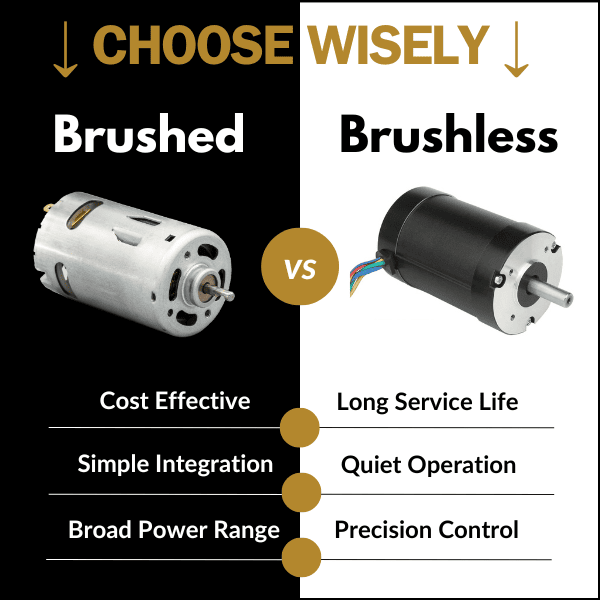



The main difference between brushless motors and brushed motors is the structure and drive method. Brushless motors use electronic commutation technology to change the direction of motor current, while brushed motors transmit current through the contact between carbon brushes and rotating commutator disks. Each motor has its own advantages.
Advantages of brushless motors
1. Mature technology: Brushless motor technology is quite advanced and has a long history. Therefore, it is now easier and relatively cheaper to manufacture and repair brushless motors.
2. Good low-speed performance: Due to the large current, the contact resistance between the brush and the commutator is small, so the brushless motor performs well at low speeds.
3. Wide range of applications: Due to its simple design and easy manufacturing and maintenance, brushless motors are widely used in various industries, including industrial equipment and household appliances.

Advantages of brushless motors
1. High efficiency: Through the application of electronic commutation technology, the contact loss between the carbon brush and the commutator is prevented, and the overall efficiency of the brushless motor is improved.
2. Long life: Since brushless motors do not require carbon brushes, their service life is significantly increased. This is because there is no problem of carbon brush wear or replacement.
3. Low noise and low electromagnetic interference: Brushless motors have no slip rings and carbon brushes. During operation, they generate less noise and electromagnetic interference, which helps to improve the operating stability of the entire system.
4. High precision and high response speed: The brushless motor adopts electronic commutation, fast dynamic response, and high speed and position control accuracy.
Both brushless motors and brushed motors are types of electric motors, and they have different sustainability and innovation in future development.
Brushless motors are electric motors based on electronic commutation technology. Compared with traditional brushed motors, they do not need to use carbon brushes and commutators to achieve rotor commutation. This gives brushless motors the following advantages:
1. High efficiency: Brushless motors have no friction and energy loss from carbon brushes and commutators, and can more efficiently convert electrical energy into mechanical energy, improving energy consumption efficiency.
2. High power density: Brushless motors provide better power density, that is, more output power per unit volume, by utilizing cutting-edge materials and design innovations.
3. Long life: Brushless motors do not need to replace carbon brushes or commutators frequently, and their main wear parts are bearings. Therefore, brushless motors have a longer service life and require less maintenance.
4. Low noise: Due to the friction of the brushless motors and the mechanical vibration of the commutator, brushless motors are quieter than brushed motors.
5. Strong controllability: Brushless motors use electronic commutation technology to produce more precise torque and speed control, suitable for more uses.

The innovation and sustainability of brushless motors are reflected in their increased resource consumption, reduced carbon emissions and improved energy efficiency. With the rapid development of clean and renewable energy, brushless motors have broad application prospects in new energy vehicles, wind power generation, home appliances and other fields.
However, brushed motors may still be useful in some specific cases. For example, brushed motors are still used in some low-power applications and small household appliances due to their low price.
Electric motors using traditional brush and commutator technology are called brushed motors. Although they have certain disadvantages compared with brushless motors, they have the following advantages in certain specific application environments:
1. Low cost: The production cost of brushless motors is higher than that of brushed motors.
2. High reliability: In certain specific application scenarios, brushed motors have higher reliability due to their basic structure and easy manufacturing and maintenance.
3. Excellent starting and acceleration performance: Brushed motors have better starting and acceleration performance under certain high-speed and high-torque application conditions.
4. Strong temperature adaptability: Due to their simple structure, brushed motors have stronger temperature adaptability in certain specific application scenarios and can resist environmental factors such as high temperature and humidity.
5. Better performance in certain application scenarios: Brushed motors are often used in servos, model aircraft and other fields due to their small size, light weight and fast speed.