



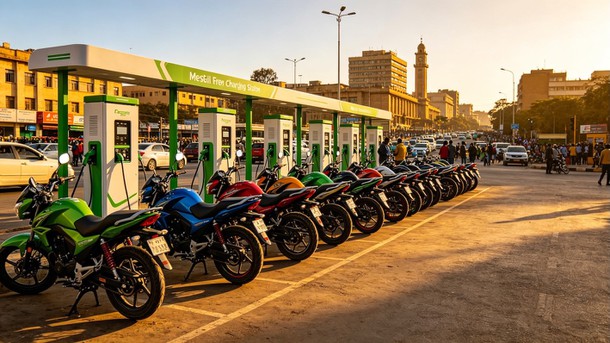
In Addis Ababa, the capital of Ethiopia, the scene of dozens of electric motorcycles queuing for charging beside the Meskel Square charging station in the city center has become the new normal. As geopolitical conflicts in the Middle East continue, global Brent crude oil prices have surged from $75 per barrel in early 2025 to $112 per barrel currently-a nearly 50% increase. For an African country like Ethiopia that imports over 95% of its petroleum, this price fluctuation has directly transmitted to the consumer market. Domestic fuel prices have risen by 83% cumulatively over the past 12 months, directly driving an unprecedented electric mobility revolution.
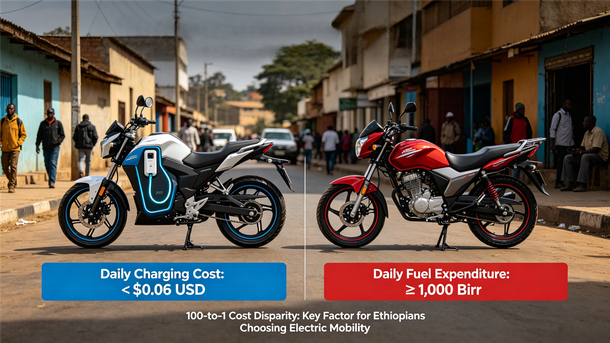
Data serves as the most compelling proof. In an interview, Bereket Worku-the local Market Manager for the Yadea brand-laid out the figures for us: "In Ethiopia, the daily cost of charging an electric motorcycle is only about 10 Birr, which translates to less than $0.06 USD; conversely, a fuel-powered motorcycle of equivalent displacement requires a daily fuel expenditure of at least 1,000 Birr." For ordinary Ethiopians-whose average daily income stands at a mere $3 to $5-this 100-to-1 cost disparity has a decisive impact. This is precisely why an increasing number of delivery riders, small-scale vendors, and daily commuters are choosing electric motorcycles without hesitation. For a demographic that sees the majority of its daily earnings consumed by transportation costs, making the switch to electric mobility is not merely an eco-friendly choice; it is, above all, a tangible strategy for economic survival.
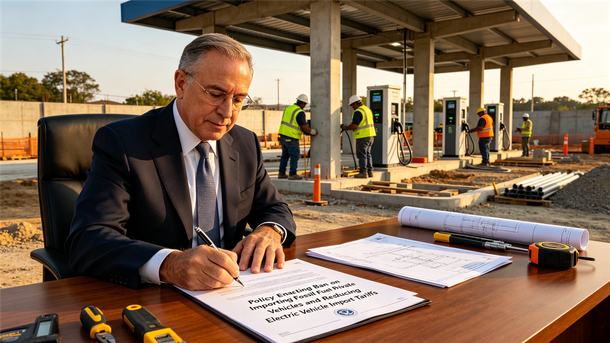
Policy support has also added momentum to this electrification revolution. In 2024, the Ethiopian government officially enacted a ban on importing fossil fuel private vehicles while significantly reducing electric vehicle import tariffs-the import tax rate for electric vehicles dropped from the original 30% to 5%, while the import tax rate for traditional gasoline vehicles increased from 35% to 50%. This policy contrast has further amplified the price advantage of electric vehicles. Simultaneously, the government launched a three-year charging infrastructure construction plan, aiming to build over 5,000 public charging stations nationwide by 2027. Although infrastructure construction currently lags behind market demand growth-which explains the long queues we see at charging stations-the explosive market growth has forced all stakeholders to accelerate deployment.
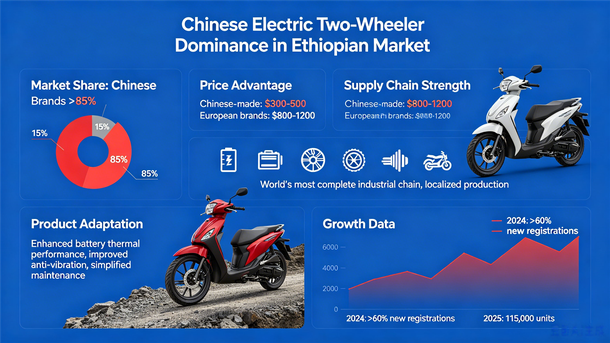
Currently, Chinese brands hold absolute dominance in the electric two-wheeler market in Ethiopia and across Africa, capturing over 85% market share. This dominant position was not achieved overnight but built on multiple competitive advantages. First is the price advantage: Chinese-made electric motorcycles sell for approximately $300-500 in Ethiopia, while comparable European brand products generally sell for $800-1200. Second is the supply chain advantage: China possesses the world most complete electric two-wheeler industrial chain, enabling large-scale localized production of core components from batteries and motors to controllers, which directly translates into cost advantages. Third is product adaptation: Chinese manufacturers have extensively optimized their products for African market characteristics, such as enhancing battery thermal performance, improving body anti-vibration capabilities, and simplifying maintenance structures, making products more suitable for African road and climate conditions. Official Ethiopian data shows that over 60% of new vehicle registrations nationwide in 2024 were electric vehicles, with EV ownership surging from 7,000 units in 2022 to 115,000 units in 2025-achieving over 15-fold growth in just three years.
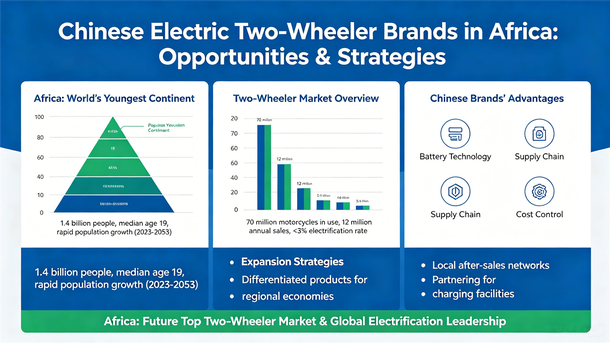
For Chinese electric two-wheeler brands including Ronghao, Africa's booming market is not only an export chance but also a strategic layout opportunity. With 1.4 billion people and a median age of 19, Africa is the world's youngest continent with rapid population growth in the next 30 years. Africa has around 70 million motorcycles and annual sales of 12 million units, yet its electrification rate is under 3%, showing huge market potential. Relying on advantages in battery technology, supply chain and cost control, Chinese brands can expand in Africa by launching differentiated products for different regional economies, building local after-sales networks, and cooperating with local partners to improve charging facilities and form core competitiveness. As Africa is set to become the world's top two-wheeler market, brands gaining solid footholds here will take the lead in the global electrification trend.
We reinforced the battery heat resistance, upgraded the shock absorption for rough roads, and simplified maintenance parts.
https://www.ronghaomotor.com/adult-motorcycle/super-powerful-motorcycle-150cc.html
