




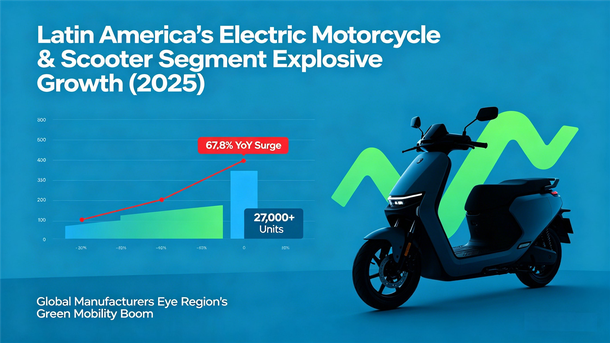
Latin America's electric motorcycle and scooter segment is experiencing explosive growth, recording a staggering 67.8% year-on-year surge in 2025 to exceed 27,000 units - a landmark milestone that has drawn the attention of global manufacturers eager to capture a slice of the region's booming green mobility wave.
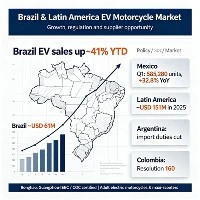
The broader motorcycle market across 16 Latin American countries registered 5.86 million total sales in 2025, the fourth consecutive record year, growing at 20.6%. Leading the charge are Colombia (+33.1%), Argentina (+33.3%), Chile (+37.2%), and Brazil (+20.6%), all posting double-digit increases as urbanization accelerates and fuel prices climb. Grand View Research projects the region's electric scooter market will hit USD 1.54 billion by 2030 at a CAGR of 6.8%, while IMARC Group forecasts even more bullish figures of USD 5.9 billion by 2034, implying an 8.85% annual growth rate. Affordable high-performance electric scooters from Chinese manufacturers are increasingly entering Brazil and Colombia through strategic distribution partnerships, making this a critical market to watch in 2026.

·Middle East & Africa Electric Scooter Market Targets USD 2.83 Billion by 2035
The Middle East and Africa (MEA) region is emerging as one of the fastest-growing electric scooter markets globally, with a projected market size of USD 2.83 billion by 2035 and a CAGR of 6.34%, according to a market report updated on April 6, 2026. The Gulf Cooperation Council (GCC) dominates with a 72% regional market share, driven by smart city initiatives in Dubai and Riyadh that include dedicated scooter lanes, parking facilities, and fast-charging stations. South Africa is identified as the fastest-growing sub-region with a 48% share of growth momentum. A pivotal shift in competitive dynamics has occurred: companies are moving away from price wars toward technology innovation, AI integration, and improved customer experience as the new battleground. Segway-Ninebot recently signed a major partnership with a leading ride-hailing platform to deploy shared electric scooter rentals across urban centers - a signal that MEA is transitioning from a purely product-sales market to a "mobility-as-a-service" model. Xiaomi's late-2025 launch of an AI-equipped scooter with advanced safety and navigation features has been particularly well-received in technology-savvy GCC markets.

·China's Export Momentum Powers Global Supply Chains - High-Performance Models Lead New Wave
China's electric two-wheeler manufacturers are reshaping global trade flows, with brands like Yadea, AIMA, and NIU leading an aggressive international expansion strategy. Chinese brands currently hold a 65% share of the Asian export market and continue to set the pace on price-to-performance ratios that emerging markets find irresistible. In the MEA corridor, Chinese manufacturers from Xishan and Wuxi are establishing direct distribution channels in Morocco, Egypt, and the UAE, leveraging proximity studies and channel visits to build sustainable import networks. On the technology frontier, the high-speed electric motorcycle sub-segment - growing at a remarkable 15.8% CAGR - is where premium Chinese exporters are staking their next competitive claim. Buyers in Latin America, the Middle East, and Southeast Asia are increasingly demanding powerful, long-range models suited to varied terrain and daily commuting needs. The 2000W high-performance electric scooter with an 80km range - exemplified by models such as the Ronghaomotor High-Performance 2000W Electric Scooter - represents the sweet spot of this global demand: robust power output, extended range, and export-ready build quality that meets the expectations of distributors and end-users from Bogotá to Casablanca to Jakarta.

High-Performance 2000W Electric Scooter | 80KM Long Range
