


Founded in 2015 and headquartered in Kenya, Watu is a leading inclusive finance and asset lease-purchase platform in Africa. Initially entering the market with motorcycle lease-purchase services, the company helps boda boda riders without bank accounts acquire transportation through low down payments and high-frequency micro installments. Later, Watu expanded its business to tricycles, electric motorcycles, as well as smartphones and tablets (Watu Simu), and now has a presence in markets across East Africa, West Africa, Mexico and beyond.
Its financing model is highly reliant on debt capital, including loans from development financial institutions, private credit, and structured accounts receivable financing, enabling capital leveraging and rapid turnover. To date, Watu has disbursed over 2 million loans across 8 countries, covering installment services for motorcycles, tricycles, electric vehicles and smart devices; among these, smart device financing has exceeded 1 million units in Kenya, and Watu ranks first in the market share of two-wheel vehicle lease-purchase business in the country.

Development History
Since entering the inclusive finance market with motorcycle lease-purchase in Kenya in 2015, Watu has continuously achieved diversified expansion, expanded to multiple African countries, and realized rapid cross-category and cross-regional growth.
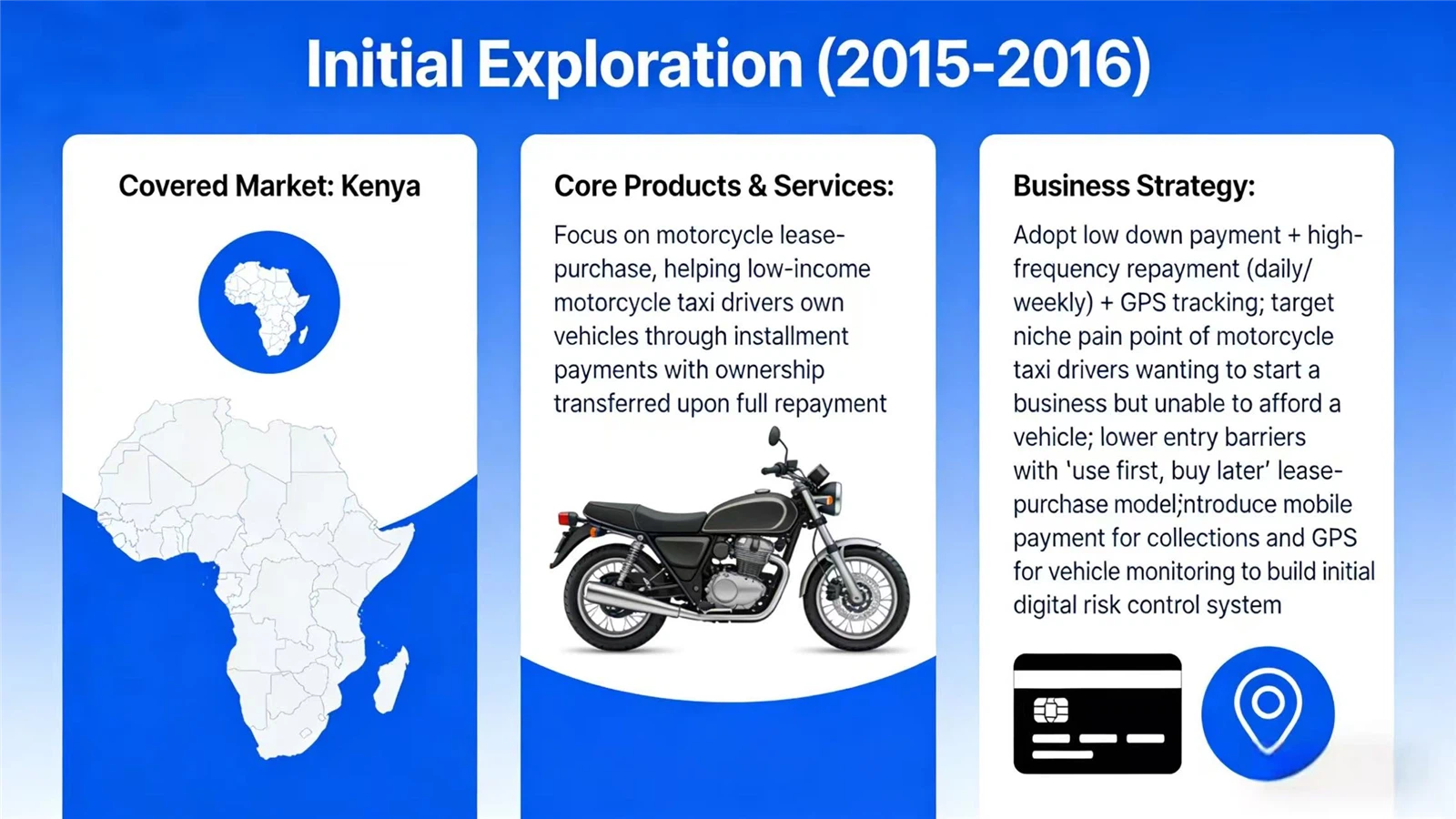
Initial Exploration (2015-2016)
Covered Market: KenyaCore Products & Services: Focus on motorcycle lease-purchase, helping low-income motorcycle taxi drivers own vehicles through installment payments with ownership transferred upon full repayment.Business Strategy: Adopt a model of low down payment + high-frequency repayment (daily/weekly) + GPS tracking; focus on the niche pain point of motorcycle taxi drivers who want to start a business but cannot afford a vehicle; lower entry barriers with a "use first, buy later" lease-purchase model for high user acceptance; introduce mobile payment for collections and GPS for vehicle monitoring to initially build a digital risk control system.
Expansion Period (2017-2018)
Covered Market: East Africa (deepened presence in Kenya, expanded to Uganda and Tanzania)Business Strategy: Regional replication of the successful motorcycle lease-purchase model from Kenya in Uganda and Tanzania; rapid market capture in neighboring countries with developed
motorcycle taxi industries; replicate standardized processes with unified lease-purchase contracts, GPS and mobile payment systems.

Diversified Expansion (2019-2021)
Covered Market: Kenya, Uganda, Tanzania, RwandaCore Products & Services: Launched Watu Gari (automobile financing) beyond motorcycle lease-purchase, a model closer to traditional auto loans than lease-purchase; piloted Watu Simu for smartphone and tablet lease-purchase.Business
Strategy: Horizontal diversification by extending from motorcycle lease-purchase to automobile and smart device financing to broaden the customer base.
Internationalization (2022-Present)
Covered Market: Kenya, Uganda, Tanzania, Rwanda, Sierra Leone, Nigeria, Democratic Republic of the Congo, MexicoCore Products & Services: Expanded the lease-purchase model to electric motorcycles through partnerships with Ampersand, Roam and other manufacturers.
Business Strategy: Digitalization with the launch of Watu App and WhatsApp customer service supporting cross-border operations; strategic alliances with manufacturers to drive large-scale development; combine localization and scale by replicating the lease-purchase model in various countries while adjusting terms according to local conditions.
Business Model
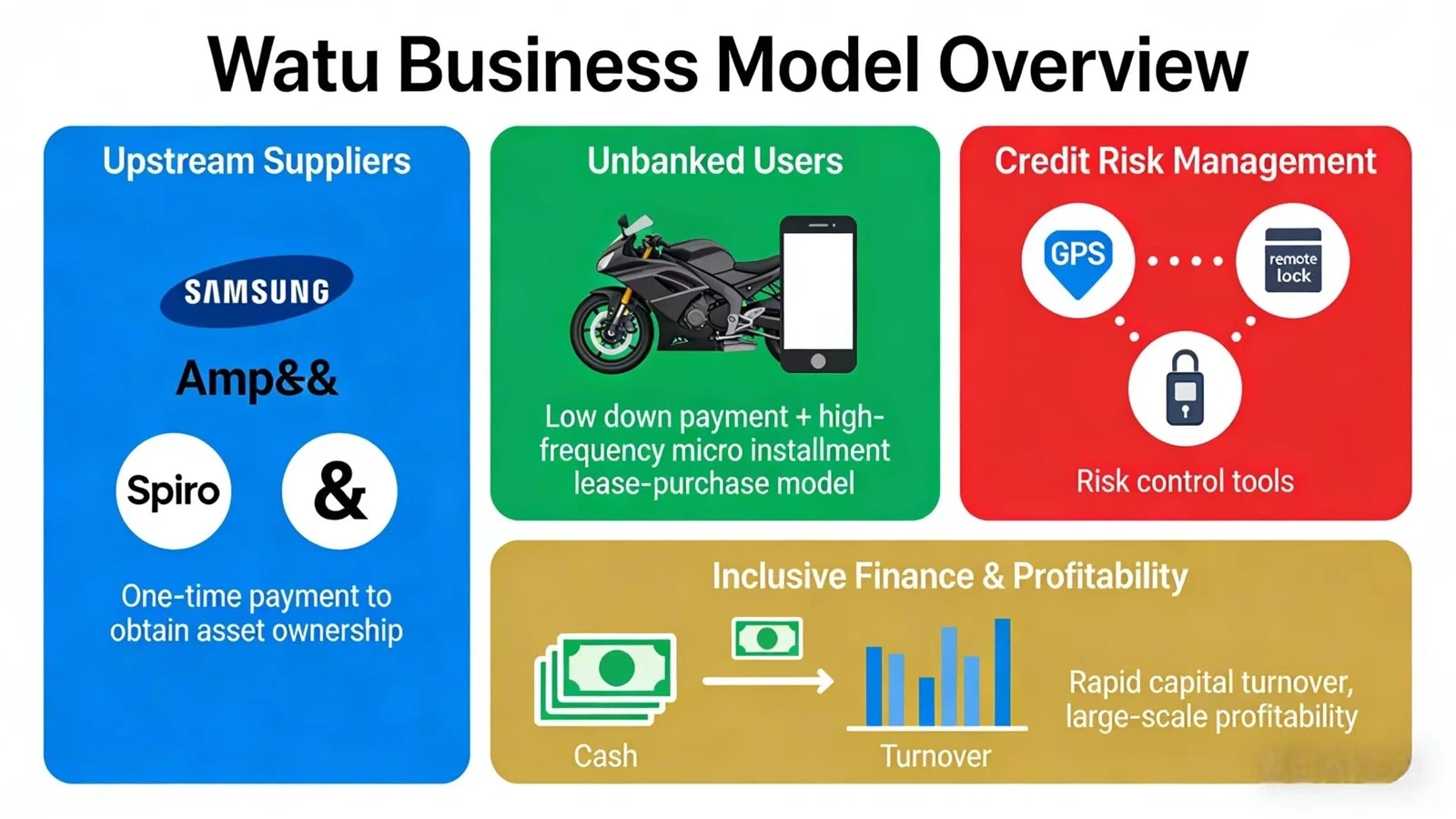
Watu recovers cash flow through high-frequency installments and reduces bad debt risks with GPS/remote lock control, insurance and guarantee networks, achieving rapid capital turnover and large-scale profitability.
Watu makes one-time payments to upstream suppliers (OEMs such as Samsung, and distributors such as Spiro and Ampersand) to obtain asset ownership, then delivers motorcycles and smartphones to unbanked users through a "low down payment + high-frequency micro installment" lease-purchase model. It manages credit risks with GPS/remote lock control, insurance and guarantee networks, forming a closed loop of inclusive finance and large-scale profitability.
Installment Plans
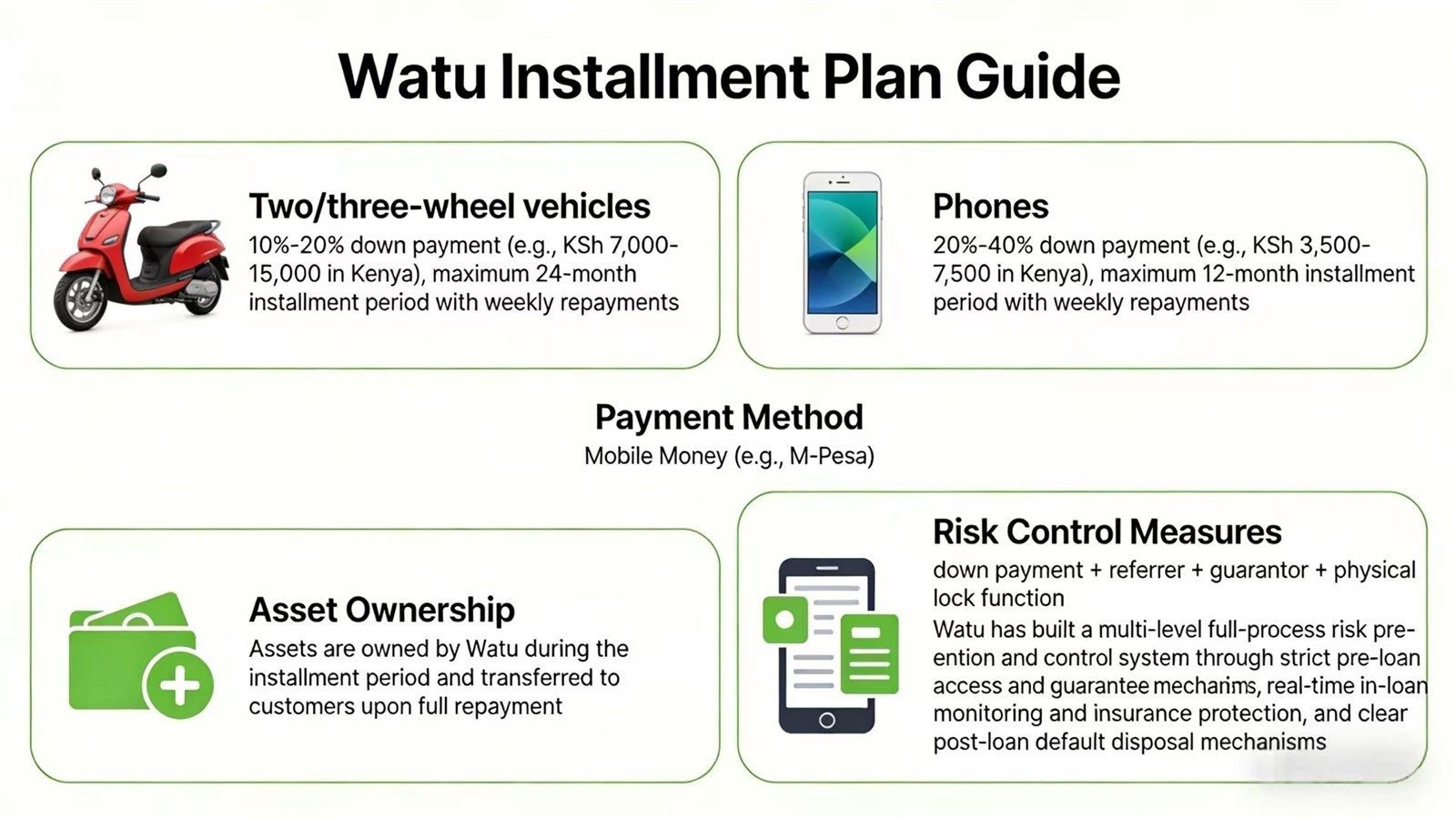
Two/three-wheel vehicles: 10%-20% down payment (e.g., KSh 7,000–15,000 in Kenya), maximum 24-month installment period with weekly repayments.
Phones: 20%-40% down payment (e.g., KSh 3,500 - 7,500 in Kenya), maximum 12-month installment period with weekly repayments.
Payment Method
Mobile Money (e.g., M-Pesa)
Asset Ownership
Assets are owned by Watu during the installment period and transferred to customers upon full repayment.
Risk Control Measures
Down payment + referrer + guarantor + physical lock function
Risk Control System
Watu has built a multi-level full-process risk prevention and control system through strict pre-loan access and guarantee mechanisms, real-time in-loan monitoring and insurance protection, and clear post-loan default disposal mechanisms.
Pre-loan Approval
KYC Requirements: Borrowers must provide a national ID card, tax ID number and Mobile Money number.
Down Payment Threshold: 10%-20% for two/three-wheel vehicles, 20%-40% for mobile phones.
Guarantee Network: 1-2 guarantors (not required for electric motorcycles in some regions) and 1-2 referrers. Guarantor information is included in the contract, and Watu will hold guarantors accountable or even require compensation in case of borrower default. Referrers are usually from the borrower's community/family, acting as human credit references; this mechanism leverages the interpersonal constraints of the community to prevent borrowers from defaulting easily.
In-loan Monitoring
Physical/Technical Lock Control
Vehicles: GPS trackers are installed with contract authorization, allowing Watu to remotely control/turn off the engine; tampering with or removing trackers is deemed a default. In addition, Watu cooperates with electric motorcycle suppliers, and batteries often adopt BMS + battery swap networks, making it impossible to retrieve batteries from swap stations if payments are overdue.
Phones (Watu Simu): System-level remote locking is adopted; in partnership with Samsung, anti-flashing functions are available, and flashing/tampering with the system triggers permanent locking.
Insurance: Vehicles must be insured with Watu as the first beneficiary. In case of total loss/theft, Watu can negotiate with insurance companies and receive compensation on behalf of the borrower; the borrower is still liable for any shortfall in compensation.
Post-loan Default Disposal
Late Fees and Collection
A daily late fee of 0.5% is charged for overdue installment payments.
A collection fee of KSh 5,000 is added for payments overdue by more than 10 days.
Collection channels: SMS/phone calls/on-site follow-ups; vehicle repossession is initiated when necessary.
Repossession and Grace Period
For two/three-wheel vehicles, repossession measures are usually initiated after 2 weeks of overdue payments; a 7-day grace period is granted after repossession. Customers can retrieve the vehicle upon payment of overdue installments and a late fee of KSh 5,000, otherwise the vehicle will be resold after further processing.
For mobile phones, repossession is generally not conducted due to low residual value, but permanent locking prevents resale and urges customers to continue making payments.
Industry Moat
Relying on upstream and downstream ecological synergy, coupled with an asset-light model and a strong risk control closed loop, Watu has built an industry moat with low working capital, high expansion flexibility and predictable loan recovery.
Advantages in Capital and Financing Channels
Watu has formed a significant barrier on the capital side. On the one hand, the company has long received continuous support from diverse channels such as development financial institutions (DFIs), international private credit funds and local banks, building a stable and relatively low-cost capital source. On the other hand, Watu pledges the future installment cash flow of customers to financial institutions through "accounts receivable financing", achieving rapid capital recovery and recycling. This mechanism significantly improves capital utilization efficiency, enabling the company to maintain large-scale loan disbursement and continuous expansion with limited own capital.
Distribution and Channels
Watu has established stable partnerships with a large number of local motorcycle distributors and smartphone brands (e.g., Samsung), and has dozens of branches and service outlets in Kenya, Uganda, Sierra Leone, Rwanda and other places. Through an extensive distribution network and physical touchpoints, Watu can embed financial services at the first moment customers purchase vehicles or phones, building a cross-border customer acquisition and delivery system. The first-mover advantage of this distribution and channel layout makes it difficult for competitors to replicate its market reach in a short time.

Technology and Risk Control
Watu's risk control system covers the entire pre-loan, in-loan and post-loan process:
Pre-loan: Make up for the lack of credit reporting with community credit through strict KYC, down payment thresholds, and guarantor and referrer systems.
In-loan: Motorcycles and tricycles are equipped with GPS, remote engine cut-off and geofencing in some markets; electric vehicles rely on BMS and battery swap networks to control usage rights; smartphones adopt remote locking and anti-flashing mechanisms to ensure asset control even in the hands of customers. All repayments are completed through mobile payment to form capital traces, supplemented by insurance protection.
Post-loan: Implement tiered collection, asset repossession and device locking for overdue customers.
