


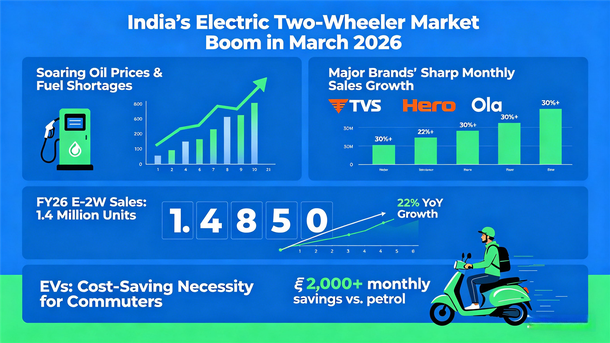
India's electric two-wheeler market boomed in March 2026 amid soaring oil prices and fuel shortages. Major brands posted sharp monthly sales growth. FY26 e-2W sales rose 22% YoY to 1.4 million units, making EVs a cost-saving necessity for commuters.
Section 1 - India: West Asia Oil Crisis Ignites Record EV Surge, FY26 E-2W Sales Hit 1.4 Million
India's electric two-wheeler market hit an unprecedented inflection point in March 2026, as escalating West Asian conflict pushed Brent crude above USD 110/barrel and triggered domestic fuel shortages, long queues at petrol stations, and whispers of fuel rationing. EV registrations surged accordingly. March 2026 became the single highest month on record: TVS Motor led with 49,453 units (+55% MoM), Bajaj Chetak sold 46,246 units (+81% MoM), and Ather Energy moved 35,688 units (+71% MoM). Even the struggling Ola Electric saw a dramatic 150% monthly recovery to 10,117 units. Full FY26 annual retail totaled approximately 1.4 million units, up 22% YoY, representing 57% of all EVs sold in India. EVINDIA analysts observed that this is no longer an environmental choice - it is a survival imperative. With petrol costs consuming an ever-larger share of commuter budgets and petrol prices breaking psychological barriers in major cities, the e-2W has been reframed as a tool for personal energy independence. Hero Vida's success in small towns, aided by its battery-swap model, further demonstrates that geographic expansion beyond metro cities is now underway.

Section 2 - Africa: USD 150M+ Capital Infusion Reshapes Battery-Swap Landscape, Spiro Dominates
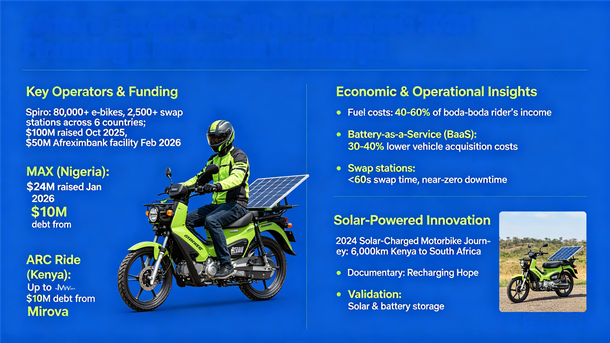
Africa's electric two-wheeler market entered a new financing era in 2026, with over USD 150 million in disclosed rounds flowing into the sector since late 2025. Spiro - Africa's largest integrated operator - commands 80,000+ electric bikes and 2,500+ swap stations across Kenya, Uganda, Rwanda, Nigeria, Benin, and Togo, raising USD 100 million in October 2025 and a further USD 50 million facility from Afreximbank in February 2026. Nigeria's MAX raised USD 24 million in January 2026, while Kenya-based ARC Ride secured up to USD 10 million in debt from Mirova. The economics are compelling: fuel costs absorb 40-60% of a boda-boda rider's gross income. Battery-as-a-Service (BaaS) cuts vehicle acquisition costs by 30-40%, enabling subscription models that reduce daily operating costs. Swap stations now complete swaps in under 60 seconds, achieving near-zero downtime. Simultaneously, a landmark experiment in 2024 saw a team ride a locally manufactured Kenyan solar-charged electric motorbike 6,000km from Kenya to South Africa - validated entirely on solar and battery storage - producing the documentary Recharging Hope and proving that Africa's energy transition and EV transition are inseparable.
Section 3 - Southeast Asia: Fuel Shortages and 18x Cost Advantage Rewrite Consumer Preferences
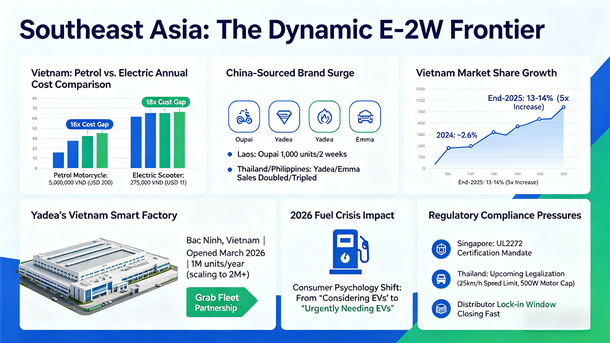
Southeast Asia continues to be the most dynamic e-2W frontier globally. In Vietnam, petrol motorcycles cost approximately 5 million VND (USD 200) per year in fuel - versus just 275,000 VND (USD 11) for an electric scooter - an 18x annual cost gap that is rapidly converting consumers. China-sourced brands surged: in Laos, Oupai sold 1,000 units in two weeks; Yadea and Emma doubled or tripled sales in Thailand and the Philippines. Yadea's USD 100 million smart factory in Bac Ninh, Vietnam (opened March 2026) has an initial capacity of 1 million units/year, scaling to 2 million+, and anchors its Grab fleet partnership. Chinese brands' collective Vietnam market share rocketed from approximately 2.6% in 2024 to 13-14% by end-2025 - a 5x increase in under 18 months. The 2026 fuel crisis has done what years of government EV incentives could not: shifted consumer psychology from 'considering EVs' to 'urgently needing EVs'. Meanwhile, compliance pressures are rising: Singapore mandates UL2272 certification for all e-scooters on public roads, and Thailand's upcoming legalization framework is expected to set a 25km/h speed limit and 500W motor cap - the window to lock in distributors before regulations tighten is closing fast.
Section 4 - Latin America: Argentina +45.5%, Colombia +17.9% - E-Scooter Adoption Enters Mainstream Phase
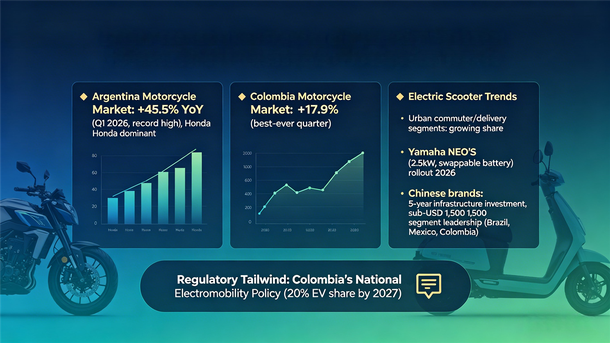
Latin America's motorcycle and e-scooter markets both posted historic Q1 2026 results, suggesting the region has entered a mainstream adoption phase. Argentina's overall motorcycle market hit a record high in Q1 2026, growing 45.5% year-on-year, with Honda retaining its dominant leadership. Colombia's motorcycle market recorded its best-ever quarter, with sales up 17.9%. Against this backdrop of motorcycle market expansion, electric variants are capturing growing share - particularly in urban commuter and delivery segments. Yamaha Motor is rolling out its NEO'S electric scooter (2.5kW, swappable battery) across Latin American markets in 2026, signaling that major Japanese OEMs now view the region as a strategic EV battleground. Chinese brands hold a commanding position in the sub-USD 1,500 entry-level segment across Brazil, Mexico, and Colombia, supported by five years of logistics and after-sales infrastructure investment. Colombia's National Electromobility Policy mandating 20% EV share of new two-wheelers by 2027 continues to provide regulatory tailwind. The convergence of booming overall motorcycle demand, rising fuel costs, and favorable policy creates a uniquely favorable window for e-2W penetration in the region.
Section 5 - Global Outlook: Chinese Manufacturers Pivot to Quality-Led International Expansion as Domestic Market Cools
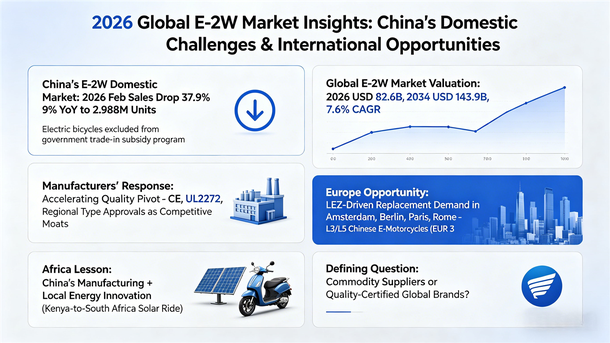
As international markets heat up, China's domestic e-2W market faces mounting headwinds. With electric bicycles removed from the government's trade-in subsidy program, February 2026 sales dropped 37.9% year-on-year to 2.988 million units - a sharp contrast to the explosive overseas demand. Manufacturers are responding by accelerating the quality-first pivot: investing in CE, UL2272, and regional type approvals as competitive moats rather than compliance overhead. The GM Insights market model values the global e-2W market at USD 82.6 billion in 2026, growing to USD 143.9 billion by 2034, with a 7.6% CAGR in the dedicated electric scooter and motorcycle segment. Chinese exporters are no longer competing solely on price - they are competing on certifications, warranty networks, and supply chain depth. In Europe, the LEZ-driven replacement demand for combustion-engine scooters in Amsterdam, Berlin, Paris, and Rome creates a clear opportunity for L3/L5 category Chinese e-motorcycles in the EUR 3,000-7,000 bracket. For Africa, the lesson from the Kenya-to-South Africa solar ride is clear: China's manufacturing capability combined with local energy innovation creates a compelling value proposition. The defining question for 2026 and beyond is not whether Chinese manufacturers will dominate global e-2W supply - it is whether they will do so as commodity suppliers or as quality-certified global brands.
Carbon-Neutral Commuting with Eco E-Motorcycles:
https://www.ronghaomotor.com/adult-motorcycle/zero-carbon-travel-electric-motorcycles-an.html